古代 中国 Architecture at Fengxue 寺庙: Timeless Zen and National Treasures
Temples & Religious Buildings
古代 中国 Architecture at Fengxue 寺庙: Timeless Zen and National Treasures的行程重点、背景信息和实用参观提示,帮助旅行者更轻松地规划中国之行。
中文导览:Introduction
中文导览:Morning mist threads through the pines on Fengxue Mountain, revealing an ancient temple nestled among cedars and cypresses. This is Fengxue Temple in Ruzhou — a Buddhist sanctuary more than 1,800 years old where Tang pagoda masonry, Song dynasty bronze bell tones, and the solemnity of a Jin-era main hall meet today’s sunlight. Entering the courtyard feels like stepping onto the rings of history: the Seven Ancestors Pagoda still holds echoes of Tang chants, the rust of the bell pavilion stores the sound of a northern capital’s mornings, and the eaves and brackets of the central hall show traces of Yingzao Fashi craftsmanship. More than one of the “three great Central Plains temples,” Fengxue is a living museum of ancient Chinese architecture, waiting for visitors to measure it by foot and converse with it in silence.
中文导览:1. History: A Buddhist Treasure in the River of Time
中文导览:One-line essence: The most intact millennium-old Buddhist complex in the Central Plains — a three-dimensional chronicle from the Eastern Han to today. 中文导览:Fengxue Temple traces its origins to the first year of Jianping (190 AD) in the Eastern Han, shortly after Buddhism arrived in China. Built high in a wooded valley, it quickly became a center of worship. In the Tang dynasty the site reached its peak as the monastery of Chan master Shenhui, and the Seven Ancestors Pagoda was erected in his memory. Through the Song, Jin, Yuan, Ming and Qing dynasties, the temple’s incense never died out; successive repairs and additions accumulated like tree rings, recording the evolution of Chinese Buddhist art. 中文导览:Unlike many temples rebuilt in modern times, Fengxue unusually preserves the original layout of its ancient building cluster. In 1988 it was designated a Major Historical and Cultural Site Protected at the National Level. Its value is both religious and architectural: the complex is a key to understanding traditional Chinese timber construction, Chan (Zen) practice, and regional history.
中文导览:2. Three National Treasures: An Architectural Symphony Across Time
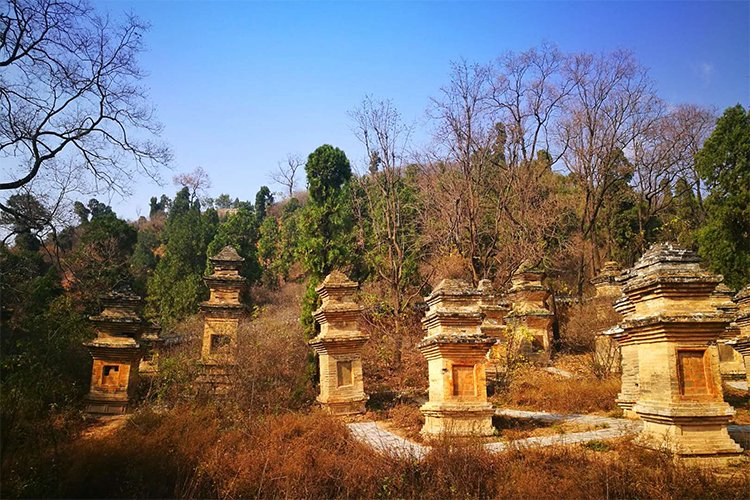
中文导览:Seven Ancestors Pagoda (Tang dynasty)
中文导览:The pagoda rises 24 meters with nine tiers of overlapping eaves, built in 738 (the 26th year of Kaiyuan). Despite earthquakes and war, it stands with austere dignity: no ornate carvings, only disciplined proportions and spare, layered eaves that express the grandeur of the high Tang. Up close, the lime mortar between bricks shows age and crazing, and the wind charms — the small wind bells on each tier — still ring faintly in the mountain breeze. These are Tang craftsmen’s “sound fossils.”
中文导览:Bell Pavilion (Song dynasty)
中文导览:The pavilion houses a Song-era iron bell weighing about 8,000 jin (roughly four metric tons). Its surface is inscribed with Sanskrit sutras. If you are there at dawn you may hear monks strike the bell; the vibration washes across the valley in ripples, giving birth to the famed “Fengxue bell sound.” The bell’s sonority makes the mountain itself part of the monastery’s liturgy.
中文导览:Main Hall (Zhongfo Hall, Jin dynasty)
中文导览:Jin-period timber buildings are rare in the Central Plains, and the single-eave xieshan-roofed Zhongfo Hall is textbook-perfect. The bracket sets, column bases and proportions follow the Song architectural manual Yingzao Fashi closely. Inside, remnants of original polychrome paint survive on beams and trusses; looking up at the painted caisson is like watching Jin-era carpenters assemble frames and sketch patterns with their hands.
中文导览:
中文导览:3. Immersive Experiences: Dual Healing of Zen and Nature
中文导览:– Morning bell and evening drum: Arrive before 6:00 a.m. to observe morning liturgy. Sutra chanting, joined with wooden fish and birdsong, forms a natural soundtrack for meditation. 中文导览:– Eight scenic spots: The temple grounds include features such as the “Pearl Curtain” waterfall and the ancient “Great Mercy Spring” well. Walk the stone paths up to Jinping Screen Cliff to see Tang-era line-carved Buddha figures flowing across the rock face. 中文导览:– Temple vegetarian fare: The refectory serves simple noodle bowls (about ¥10 each) made from the temple garden’s produce — clean, subtle flavors with a natural sweetness.
中文导览:4. Practical Tips: How to Avoid Crowds and Travel Smart
中文导览:– Best times: 07:00–09:00 or after 16:00 for soft light and fewer people — ideal for photography. 中文导览:– Dress code: In summer, cover shoulders and knees out of respect; in winter, bring a windproof layer since the halls are unheated. 中文导览:– Beware of tourist traps: Vendors outside the temple may sell “blessed” charms. Purchase ritual items only at the temple’s official store or from authorized monastic channels. 中文导览:– Getting there: 中文导览:– Taxi: About 20 minutes from Ruzhou city center (roughly ¥30). Set your destination as “Fengxue Temple mountain gate.” 中文导览:– Bus: Take Ruzhou Bus No. 8 to “Fengxue Temple” stop, then a 15-minute uphill walk (cobbled path lined with ancient cypress trees — a ceremonial approach).
中文导览:
中文导览:Conclusion
中文导览:Time at Fengxue Temple is not a straight line. Tang bricks, Song iron and Jin timber breathe alongside today’s sunlight. When you touch the worn base of the Seven Ancestors Pagoda or sit quietly in the Zhongfo Hall and feel the corner bells tremble, you may realize the temple’s truest treasure is not the “national relic” label but its unforced authenticity. Like a silent elder, it needs no grand words — only your slowed pace to open a millennium-spanning dialogue.
中文导览:Practical snapshot
中文导览:Location: Fengxue Temple, Fengxue Mountain, Ruzhou, Henan Province 中文导览:Best seasons: Spring and autumn for comfortable weather and clear mountain views 中文导览:Entrance: Check local listings for seasonal opening hours and any preservation-related closures 中文导览:Local tip: Combine the visit with other Central Plains heritage sites to appreciate regional architectural continuity.
https://chinawondersguide.com/zh-Hans/ancient-chinese-architecture-fengxue-temple/